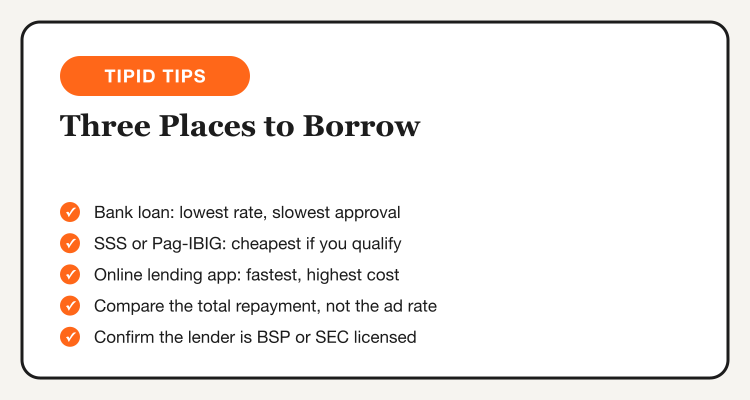
Three Places to Borrow, Three Different Tradeoffs
When Filipinos say "personal loan," they usually mean one of three things: a bank-issued unsecured loan, a government fund loan through SSS or Pag-IBIG, or a loan from an online lending app. All three exist to give you a lump sum you repay over fixed monthly installments, but they differ sharply in who qualifies, how fast the money arrives, and what it costs.
None of these categories is universally the "best" option. A bank loan usually costs less per peso borrowed but takes longer and demands more paperwork. A government fund loan can be the cheapest option available to a qualified member, but the amount is capped by your contribution history. An online lender is often the fastest and most accessible, but that convenience is priced into the rate.
| Lender type | Typical approval time | Indicative rate range | Best suited to |
|---|---|---|---|
| Bank personal loan | Several business days to a few weeks | Generally the lowest of the three, single-digit to low double-digit annual range | Employed applicants with documented income and time to wait |
| SSS / Pag-IBIG loan | Days to a few weeks, branch dependent | Usually the lowest available to a qualified member | Active, qualified members with sufficient contributions |
| Online lending app | Same day to a few hours in many cases | Generally higher than banks, varies widely by lender and term | Urgent, smaller amounts, or thin credit history |
Treat the rate column as a starting point for research, not a quote. Actual pricing depends on your credit profile, the loan amount, and the term you choose, and every lender updates its rates periodically. Confirm current rates directly with the provider before you apply anywhere.
Bank Personal Loans: Lower Cost, More Paperwork
Banks regulated by the Bangko Sentral ng Pilipinas (BSP) tend to offer the lowest personal loan rates in the market, because they fund lending from deposits and price risk more conservatively than app-based lenders. The cost of that lower rate is a longer process. Expect to submit a valid ID, proof of billing, and proof of income, then wait for credit evaluation before disbursement.
BDO personal loan promos and BPI loan offers both run periodic rate discounts or waived processing fees tied to promo windows, which is worth checking before you commit to a standing rate. Existing depositors and payroll account holders at either bank sometimes get faster processing since the bank already holds their income verification on file.
If your credit history is short or your income is informal, a bank may decline or offer a smaller amount than requested. That is not necessarily a sign to give up on banks entirely. Building a track record with a savings account, a secured credit card, or a smaller loan product first can improve your standing for a future application.
Loan terms matter as much as the rate itself. A shorter term means higher monthly payments but less interest paid overall, while a longer term lowers the monthly burden and raises the total cost. Banks in the Philippines commonly offer terms ranging from about one to five years on unsecured personal loans, and choosing the shortest term your budget can comfortably absorb is usually the cheapest path through the loan.
Co-borrowers and guarantors can also change the picture. Some banks allow a co-maker to strengthen a weaker application, which can unlock a lower rate or a larger approved amount than a solo applicant would receive. This works best when the co-maker has a documented income history the bank can verify, since an unverifiable co-maker adds little to the application.
Government Fund Loans: Cheapest If You Qualify
SSS salary loans and Pag-IBIG multi-purpose loans are funded from member contributions rather than priced for commercial profit, which is why they usually undercut both bank and app-based rates for members who qualify. The catch is the ceiling. Your maximum loanable amount is tied directly to your contribution history and salary credit, not to your current income need.
Processing can also vary a great deal by branch and by whether you apply online or in person. Online applications through the SSS or Pag-IBIG member portals tend to move faster than branch visits, but disbursement timing still depends on your standing membership status and any existing unpaid balances with either fund.
Eligibility for both funds generally requires a minimum number of posted monthly contributions and no outstanding delinquency on a prior loan from the same fund. Members who have taken a loan before and repaid it on time typically qualify for a higher amount on their next application, since the fund treats a clean repayment history as a positive signal, similar to how a bank treats a good credit record.
One detail borrowers often miss is that Pag-IBIG loan proceeds and SSS salary loan proceeds are usually released through payroll-linked or designated bank accounts rather than cash pickup in many cases, so keeping your registered bank account details current with both agencies avoids a delay at the disbursement stage. A mismatched or closed account is one of the more common reasons a government fund loan release gets held up after approval.
Online Lending Apps: Fastest, but Read the Total Cost
Online lenders exist because banks and government funds cannot serve every borrower quickly enough. A licensed lending or financing company registered with the Securities and Exchange Commission (SEC) can legally offer personal loans through an app, usually with same-day or same-hour approval and minimal paperwork.
The speed comes at a cost. Because these lenders serve borrowers banks often decline, effective rates run higher, and short repayment terms can make the true annualized cost look steep compared to a bank product. Before accepting an offer, look for the total repayment amount stated clearly, not just a daily or per-hundred-pesos rate that hides the full cost until later.
Our guide to spotting legit loan apps in the Philippines covers the specific registration checks and collection-practice red flags worth running before you download an unfamiliar lending app.
Term lengths on online loans tend to run much shorter than bank products, often measured in weeks or a handful of months rather than years. A short term concentrates the fees and interest into a compressed repayment window, which is a large part of why the effective annualized cost looks high even when the peso amount of interest paid is small in absolute terms. Judging an online loan purely by the monthly figure without checking the term length is a common way borrowers underestimate what they are agreeing to.
Repeat-borrower programs are common among app-based lenders, where a first small loan repaid on time unlocks a larger amount and sometimes a lower rate on the next cycle. This can work in a borrower's favor if used deliberately to build a track record, but it can also encourage taking on more debt than originally needed. Treat a credit limit increase as an offer to evaluate, not an amount you are obligated to borrow.
How to Shortlist a Personal Loan Without Overpaying
- Start with what you qualify for at SSS or Pag-IBIG. If the ceiling covers your need, it is usually the cheapest route.
- Get at least two bank quotes. Rates and processing fees differ enough between banks to be worth the extra application.
- Add up the total cost, not the headline rate. Processing fees, documentary stamp tax, and penalties all belong in the comparison.
- Match the lender to your timeline. An urgent expense may justify a higher-cost online loan; a planned purchase rarely does.
- Ask about early repayment before signing. A pre-termination fee changes the math if you expect to pay ahead of schedule.
Matching Loan Type to Your Situation
A steady employee with a documented salary and no urgent deadline is usually best served checking Pag-IBIG or SSS eligibility first, then comparing bank offers if the fund ceiling falls short. A self-employed borrower with irregular income may find banks harder to qualify for and get more realistic terms from an online lender that assesses cash flow differently.
Borrowers facing a genuine emergency, where waiting days for bank processing is not an option, are the clearest case for an online lending app, provided the lender is properly registered and the total cost is disclosed upfront. For anything that can wait even a week or two, running the numbers against a bank or government fund option first is worth the delay.
This comparison is informational only and is not personalized financial advice. Your actual eligibility, approved amount, and rate depend on your credit profile and each lender's current terms, so confirm details directly with the provider before applying.
The Short Version
Banks cost less but take longer, government funds are cheapest for qualified members but capped by contributions, and online lenders trade a higher price for speed and lighter paperwork. Compare the total repayment amount across at least two providers, confirm rates directly with each lender, and match the loan type to how urgently you actually need the funds.
See current starting rates by bank and estimate your monthly payment with our calculator, or browse 20+ legit loan apps with sourced rates.